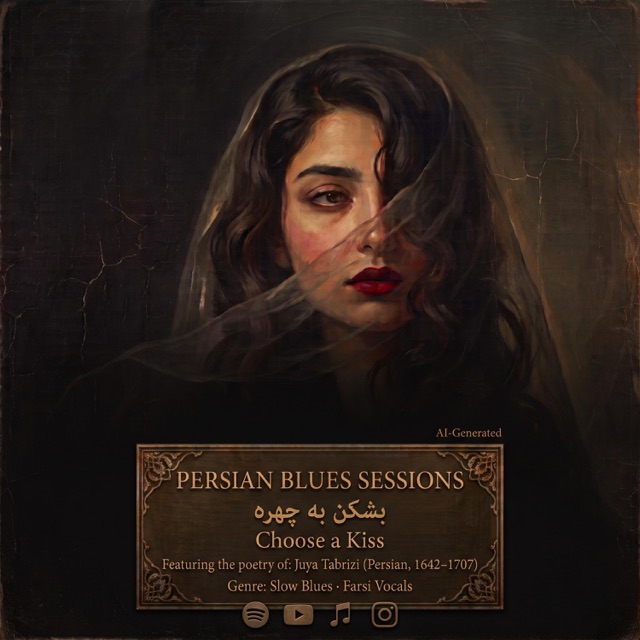
Choose a Kiss
- Poet:
- Juya Tabrizi
- Era:
- 17th century
- Slow Blues
Music & vocals AI-generated · poem in the public domain
The poem
بوسی ز کنج لعل لبش انتخاب کن
خود را به آن نگار مصاحب شراب کن
بشکن به چهره دستی می گوشهٔ نقاب
خون جگر به جام مه و آفتاب کن
بی طاقتی بس است ترا بال و پر چو موج
آسودگی مجوی دلا اضطراب کن
این عقده ها که در دلم افکنده ای به ناز
ظالم به کار طرهٔ پرپیچ و تاب کن
شیرازه تا نباخته مجموعهٔ وجود
بشکن ز غم دلت، ورقی انتخاب کن
شیرازه تا نباخته مجموعهٔ وجود
بشکن ز غم دلت، ورقی انتخاب کن
جویا مرا ز من به نمک چش گرفته است
حسن برشتهٔ دل مردم کباب کن
Ghazal No. 978 · Juya Tabrizi, Divan, Ghazals, no. 978
About the poem
A ghazal made entirely of commands. Every couplet of Juya Tabrizi's ghazal 978 lands on the same imperative radif — "-kon": choose, make, strike, seek turmoil, untie. Set as a slow blues at 62 BPM, that refrain becomes the hook, and after every line a lean electric guitar answers it with a long bend that arrives late and never resolves. A single low male voice issues orders it knows will not be obeyed — until the final couplet, where the poet says his own name into an empty room and the chord is left hanging open.
Meaning & background
Juya Tabrizi (1642–1707) — Mirza Darab, writing under the takhallus «جویا», "the seeker" — was a Persian-language poet of Mughal Kashmir whose family had come from Tabriz, which is why the tradition remembers him under both cities' names. He wrote at the far geographical edge of the Persian language, in the dense, image-driven Indian style (sabk-e Hindi) of the seventeenth century, where a single couplet is expected to knot several metaphors into one turn of thought. Ghazal 978 of his Divan is built on the imperative radif «ـاب کن» — every couplet ends on a command: choose, make, strike, seek turmoil, work these knots.
The session sings six of the ghazal's eight couplets. It opens with the gentlest order — «بوسی ز کنج لعل لبش انتخاب کن», choose a kiss from the corner of the ruby lip, and make yourself wine's companion beside that idol — then hardens into the couplet the track is named for: strike a hand against the face, wine at the veil's edge, and turn the heart's blood into a cup for moon and sun. The chorus is the ghazal's restless engine: «بیطاقتی بس است ترا بال و پر چو موج» — your impatience is wing and feather enough, like the wave; do not seek ease, O heart — make turmoil. Then the plea beneath the commands: these knots you cast into my heart with such coquetry — tyrant, put them to work in your own twisting curls. The peak is the poem's deepest image, the shirazeh — the binding-thread that holds a book's gatherings together: before the volume of your being comes unstitched and is gambled away, break off a leaf from your heart's sorrow and choose a page. And in the maqtaʿ, Juya names himself: beauty has taken me from myself with a taste of salt — beauty, that roaster of people's hearts over its skewer.
Every line of this poem already works like a blues verse: a call that ends on the same word each time, waiting for its response. That is why the setting answers each hemistich not with a choir but with a single guitar bend that arrives a fraction late and stops short of resolving — the instrumental voice of an order that will not be obeyed. The speaking position is pure blues too: a man alone, wounded by someone who will not untie what they knotted, and his complaints come out as commands rather than pleading. A twelve-bar frame would fight the fourteen-syllable Persian metre, so the track borrows the blues idiom rather than the blues form — minor key, lean electric guitar with long string bends, upright bass, brushed drums, and real silence between phrases.
The arrangement is a slow blues in a 12/8 shuffle feel at 62 BPM, and its arc is drawn in pressure, not volume. It opens in an empty room — clean tremolo guitar alone, bass entering on the low root, no drums — and the voice sits low and conversational, almost spoken at the ends of lines, in plain contemporary Tehrani diction. Brushes enter only for the second verse; the chorus opens the register by one degree and no more. A sixteen-bar guitar break develops one idea slowly, circling the tonic without ever landing on it. The shirazeh couplet is the only place the baritone reaches for the top of its range — full chest, no vibrato, over a single sustained bent note — then repeats a step quieter as the band thins away. In the outro the drums are gone entirely and the voice is alone for the takhallus, slower than everything before it. The final chord never resolves: the guitar bends upward and stops just short of the tonic, fading with the question still open.
Listen