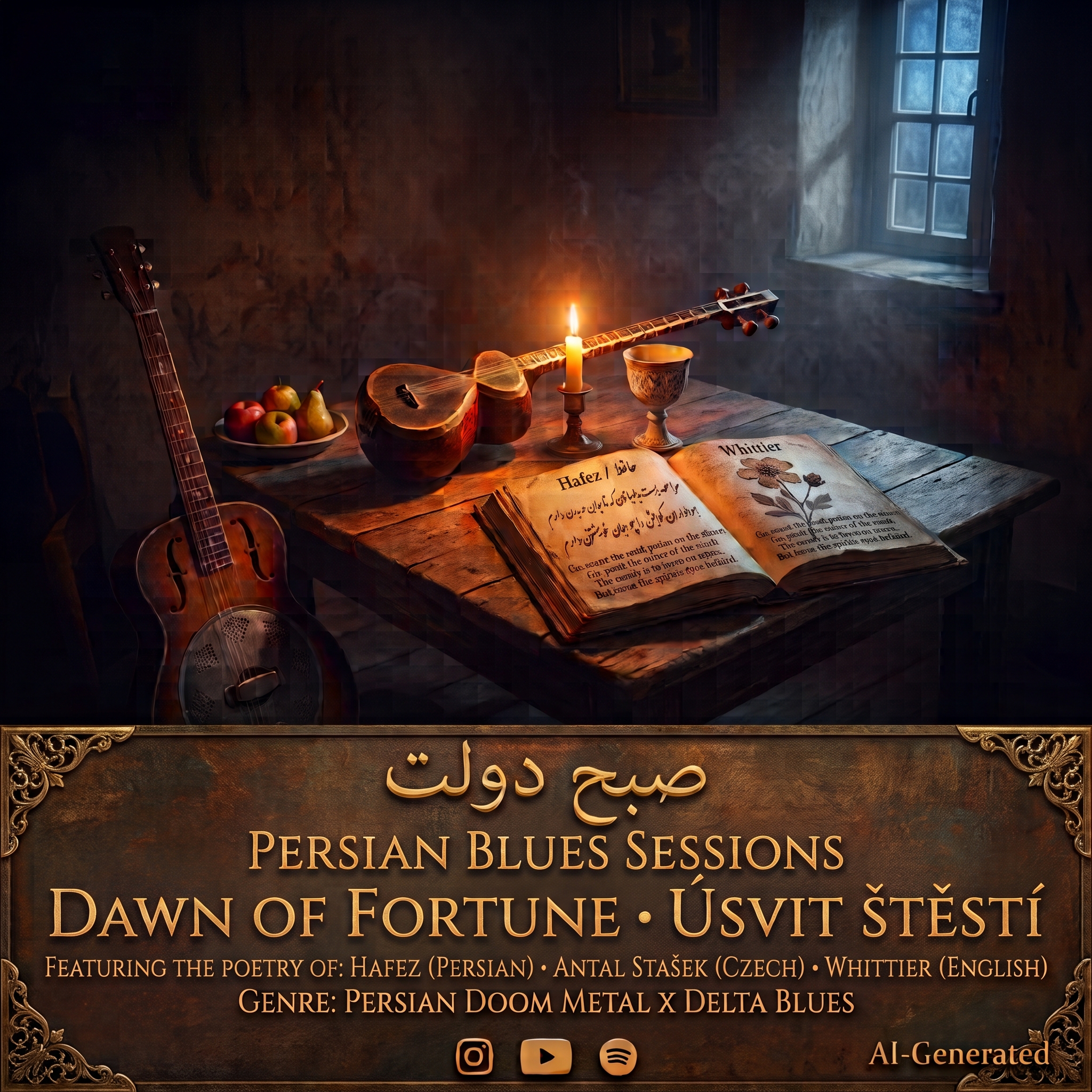
Dawn of Fortune | Úsvit štěstí
- Poet:
- Hafez · Antal Stašek · John Greenleaf Whittier
- Era:
- 14th & 19th centuries
- Persian Doom Metal x Delta Blues
Music & vocals AI-generated · poem in the public domain
The poem
صبح دولت میدمد کو جام همچون آفتاب
فرصتی زین به کجا باشد بده جام شراب
Všemohoucí jesti láska,
jako bůh, jenž v nebi trůní;
خانه بیتشویش و ساقی یار و مطرب نکتهگوی
موسم عیش است و دور ساغر و عهد شباب
A ten pohár stále plný,
stále žížniví mi rtové;
Věčná, věčná jest ta láska,
jako blankyt, slunko hvězdy,
Všemohoucí, svatá, věčná –
v bohy láska lidi mění,
Co mi svět jest se svou bídou,
věčně starostlivou tváří,
"'T is work, work, work," he muttered,—
"And for rest a snuffle of psalms!"
از خیال لطف می مشاطهٔ چالاک طبع
در ضمیر برگ گل خوش میکند پنهان گلاب
"Oh for the breath of vineyards,
Of apples and nuts and wine
شاهد و مطرب به دستافشان و مستان پایکوب
غمزهٔ ساقی ز چشم میپرستان برده خواب
Mám já hvězdy, slunka v sobě,
vedle sebe dívku svoji,
"One hundred years," quoth Keezar,
"And fifty have I told
تا شد آن مه مشتری درهای حافظ را به نقد
میرسد هر دم به گوش زهره گلبانگ رباب
But — the mighty forest was broken
By many a steepled town,
Yellow and red were the apples,
And the ripe pears russet-brown,
Pohár plný – jiskro létni,
podpálíme láskou světy,
خانه بیتشویش و ساقی یار و مطرب نکتهگوی
موسم عیش است و دور ساغر و عهد شباب
"Here's pleasure without regretting,
And good without abuse,
صبح دولت میدمد کو جام همچون آفتاب
فرصتی زین به کجا باشد بده جام شراب
Dawn of Fortune — three poems on wine, the rose, and the image · Hafez, attributed ghazals no. 2 · Antal Stašek, “Lásce.” (Básně, 1876) · J. G. Whittier, “Cobbler Keezar's Vision” (In War Time, 1864)
About the poem
Three poets, three languages, one argument about the intoxicating image. Hafez greets the dawn of fortune with a cup like the sun; Whittier's cobbler Keezar sees a promised land of vineyards in his visionary lapstone and must set it down; the Czech poet Antal Stašek declares love almighty and eternal — needing no cup and no rose at all.
Meaning & background
«صبح دولت میدمد کو جام همچون آفتاب» — “The dawn of fortune is breaking: where is the cup that shines like the sun?” The Persian spine of this session is a six-bayt ghazal that circulates under Hafez's name — Ganjoor files it among the ash'ar-e montasab, the poems attributed to him rather than fixed in the canonical Divan — and it is pure Hafezian morning: a house free of anxiety (khaneh bi-tashvish), a witty minstrel, the cupbearer's glance stealing sleep from the wine-worshippers' eyes, and Venus herself catching the sound of the rabab. The song sings five of its six couplets, and in this world the wine is not a means to anything — the party is the insight.
The Czech verses answer from the opposite pole. Antal Stašek — pen name of Antonín Zeman (1843–1931), the Krkonoše-born writer and father of the novelist Ivan Olbracht — opens his poem “Lásce.” (To Love), from his 1876 collection Básně, with a flat declaration: Všemohoucí jesti láska — “Love is almighty, like a god enthroned in heaven… eternal, eternal is that love; love turns people into gods.” Where Hafez reaches the beloved through cup, rose and morning breeze, Stašek strips every mediating image away: What is the world to me with its misery — I carry stars and suns within me. His cup, when it appears, is already and always full; nothing needs to be poured.
The English is John Greenleaf Whittier's “Cobbler Keezar's Vision” (from In War Time and Other Poems, 1864): a German cobbler among the first Puritan settlers on the Merrimack, grumbling that the new world is all “work, work, work — and for rest a snuffle of psalms,” homesick for the Rhine's vineyards. Through his mystic lapstone — cut, the legend runs, from Agrippa of Nettesheim's moonstone — he looks a hundred and fifty years ahead and sees the forest broken by steepled towns, apples yellow and red, “pleasure without regretting, and good without abuse.” It is Hafez's golden dawn transposed into prophecy: the wine and roses are real, but always still to come — and at the height of joy the lapstone tumbles into the river and the vision ends.
The three poems share one vocabulary — wine at a charged hour, the rose as proof the promise is real — and mean three incompatible things by it: for Hafez the intoxicating image is a door, for Whittier's Quaker conscience a temptation to be renounced, for Stašek an unnecessary detour. The session stages that argument in sound, under the banner of Persian Doom Metal x Delta Blues: Hafez opens modal and unhurried over a drone; Stašek lands as a hard cut, block chords hammering věčná, věčná — eternal, eternal; and Whittier's vision takes the Persian dawn-melody into a bright, almost hymn-like New England register before the cup is set down. The argument is left standing — as it should be.
Listen