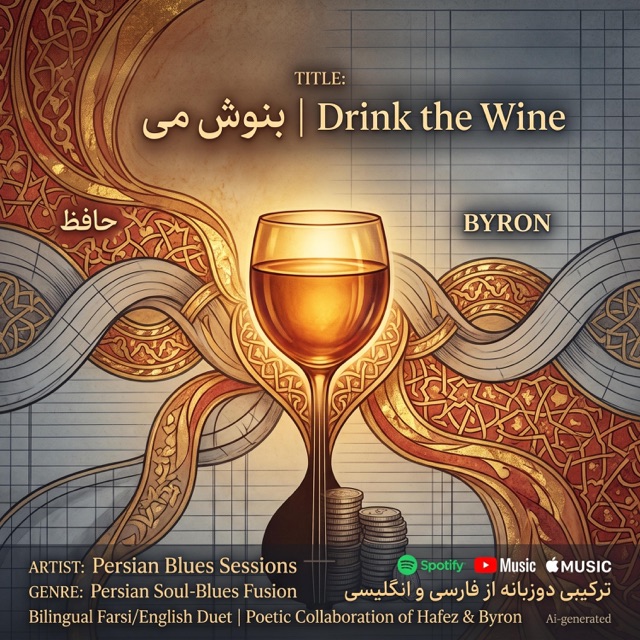
Drink the Wine
- Poet:
- Hafez · Lord Byron
- Era:
- 14th & 19th centuries
- Persian Soul-Blues Fusion
Music & vocals AI-generated · poem in the public domain
The poem
تو را که هر چه مراد است در جهان داری
چه غم ز حال ضعیفان ناتوان داری؟
بخواه جان و دل از بنده و روان بستان
که حکم بر سر آزادگان روان داری
بنوش می که سبکروحی و لطیف مدام
علی الخصوص در آن دم که سر گران داری
O Gold! Why call we misers miserable?
Theirs is the pleasure that can never pall;
Who hold the balance of the world? Who reign
O'er congress, whether royalist or liberal?
Those, and the truly liberal Lafitte,
Are the true lords of Europe. Every loan
Love or lust makes man sick, and wine much sicker;
Ambition rends, and gaming gains a loss;
But if Love do n't, Cash does, and Cash alone:
Cash rules the grove, and fells it too besides;
بنوش می که سبکروحی و لطیف مدام
علی الخصوص در آن دم که سر گران داری
مکن عتاب از این بیش جور بر دل ما
مکن هر آن چه توانی که جای آن داری
به وصل دوست گرت دست میدهد یک دم
برو که هر چه مراد است در جهان داری
چو گل به دامن از این باغ میبری حافظ
چه غم ز ناله فریاد باغبان داری؟
Ghazal 445 × Don Juan, Canto XII · Hafez, Divan, ghazal no. 445 · Lord Byron, Don Juan, Canto XII (1823)
About the poem
A bilingual duet built as an argument. Hafez's ghazal 445 addresses the one who already owns everything the world can give — and offers up the last two things a servant still holds, jan o del, soul and heart. Byron's Don Juan, Canto XII asks the same question as an auditor — "Who hold the balance of the world?" — and answers with a list of bankers. Wine, heart, soul, world and rose appear on both sides and mean opposite things: Hafez's «بنوش می» and Byron's "wine much sicker" are sung to the same melody, back to back, so one shape carries two verdicts.
Meaning & background
«تو را که هر چه مراد است در جهان داری» — "You, who have everything the world can desire" — opens ghazal 445 of Hafez's Divan, a poem whose radif (the refrain-word ending every couplet) is داری, "you have." The addressee owns everything; what remains for the poet is the gesture of giving away the only things a servant still holds: «بخواه جان و دل از بنده و روان بستان» — ask for my soul and heart, and take them freely. In the ghazal's double register the beloved and the Divine occupy the same vocative, so total possession reads at once as courtly flattery and as theology. The session sings six of its ten couplets — the opening gift, the wine couplet, the plea after reproach, the moment of union, and the closing rose — with the hook built on «بنوش می که سبکروحی و لطیف مدام»: drink wine, for it is lightness of spirit and constant refinement, especially in the moment your head is heavy.
The English voice answers from Don Juan, Canto XII (1823), the point where Byron's comic epic pauses between fool and sage to audit the world. Sung here are stanzas 3 ("O Gold! Why call we misers miserable? / Theirs is the pleasure that can never pall"), 5 — the same question Hafez's opening asserts, turned into an interrogative: "Who hold the balance of the world? Who reign / O'er congress, whether royalist or liberal?" — which Byron answers not with a beloved but with a list of financiers: Rothschild, Baring, "and the truly liberal Lafitte … the true lords of Europe. Every loan / Is not a merely speculative hit, / But seats a nation or upsets a throne." Stanza 4 delivers the counter-maxim to Hafez's hook — "Love or lust makes man sick, and wine much sicker" — and stanza 14 the canto's thesis: "But if Love don't, Cash does, and Cash alone: / Cash rules the grove, and fells it too besides." Byron's ottava rima builds seven lines of momentum and then undercuts them with a couplet; the form itself is the punchline.
The two poems share a lexicon — wine, heart, soul, world, rose — and agree on nothing, which is exactly what makes them singable against each other. Wine: for Hafez a discipline of lightness verging on the mystical; for Byron an escalation of an already sordid appetite, worth a punchline and a hangover. The heart: given away unpriced, because a servant's del is not the kind of thing that has a price — against a canto that itemises hearts, marriages and reputations at market rate. The soul: spent because spending it is the point — against a thirty-five-year-old's stocktaking of a depreciating asset. And the world: owned absolutely by the one addressed as friend and king — against a balance held by bankers. The piece's central act is placing the ghazal's addressee and Byron's answer in the same syntactic slot and letting the listener decide whether the supplication survives the accounting.
The setting is Persian Soul-Blues Fusion in straight 4/4 at 90 BPM with swung sixteenths — deliberately not a slow 12/8 blues crawl. Hafez rides a curved 3+3+2 tresillo figure that breathes and never lands square; Byron gets the same tempo flattened into a walking swing that counts four to the bar — the sound of an accountant. In the bridge both grooves play at once before the walking line drops out. The modal ground is dastgah-e Shur, whose koron (quarter-tone) third sits almost exactly where the blues third lives, so setar and slide guitar bend to the same pitch while disagreeing about what it means; piano and santur, both struck-string instruments, hand the ensemble back and forth without a seam. A male tenor sings the Persian in plain contemporary Tehrani diction; a female contralto delivers Byron dry and behind the beat, like someone reading out a price list. The last word belongs to Hafez, carrying the rose out of the garden: «چه غم ز ناله و فریاد باغبان داری» — why grieve at the gardener's cry?
Listen