About the Paper
When vision-language models (VLMs) process video frames independently, they produce semantically redundant descriptions that fail to capture the dominant, contextually coherent activity across time. Imagine a person working at a laptop who briefly reaches for a cup of tea: a memoryless VLM classifies the interlude as drinking, missing that the sustained activity is working at a laptop. We introduce ARTEMIS (Adaptive Reasoning Through Experience Memory and Intelligent Streaming), a streaming pipeline that augments VLM-based activity recognition with an explicit short-term memory (STM) buffer, enabling contextually coherent semantic aggregation.
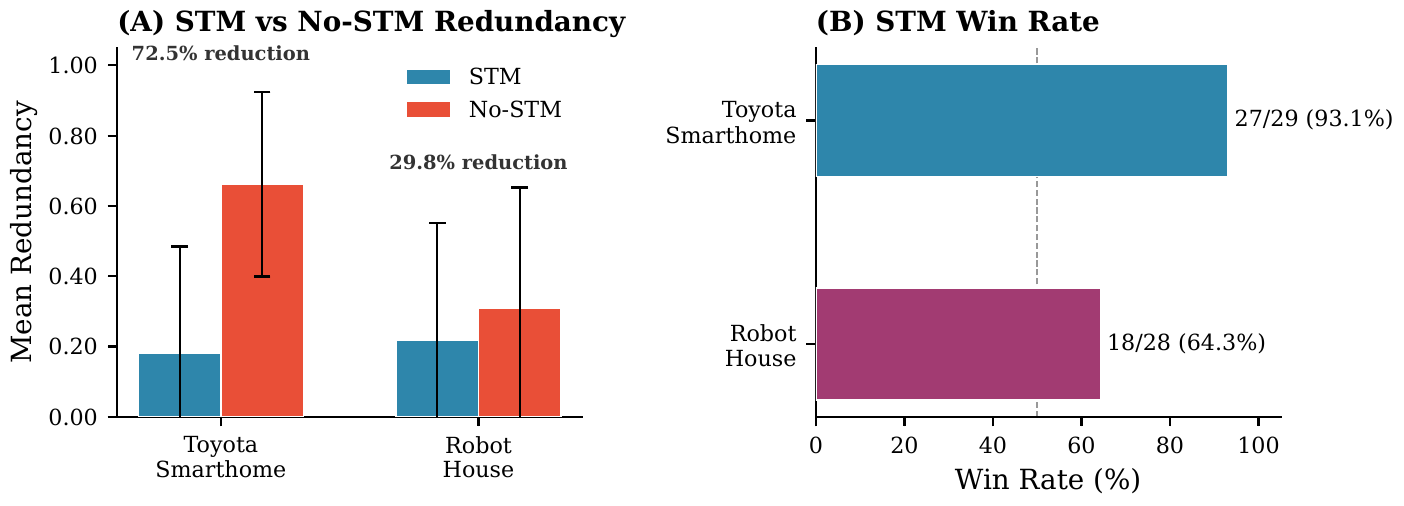
ARTEMIS pairs LLaVA-Next (8B) for per-frame captioning with a sliding buffer of the $W$ most recent descriptions and a Qwen-2.5-7B aggregator that consolidates the temporal context into a single activity representation. We evaluate redundancy reduction through paired within-video comparisons on two datasets: Toyota Smarthome (29 activity classes) and the Robot House Multi-View (RHM) dataset (14 classes, 28 videos). Across Toyota, STM delivers a 72.5% reduction in keyword redundancy with a 93% win rate (27/29 activities); on RHM continuous activities, STM yields an 82.1% reduction (Hedges' g = 1.29, padj = 0.024).
Key Insight
Memory-augmented VLMs retain temporal context to recognise the dominant sustained activity, suppressing brief transient interruptions. The STM buffer acts as an ICL-style contextual aggregator: the VLM and aggregator weights remain frozen, and adaptation arises entirely from the content of the sliding window.
The ARTEMIS Framework
A Streaming Pipeline with Short-Term Memory
ARTEMIS integrates three components operating in a continuous streaming loop: a vision-language perception module for per-frame captioning, a sliding short-term memory buffer for temporal context, and a semantic aggregation module that consolidates the buffer into a coherent activity representation.
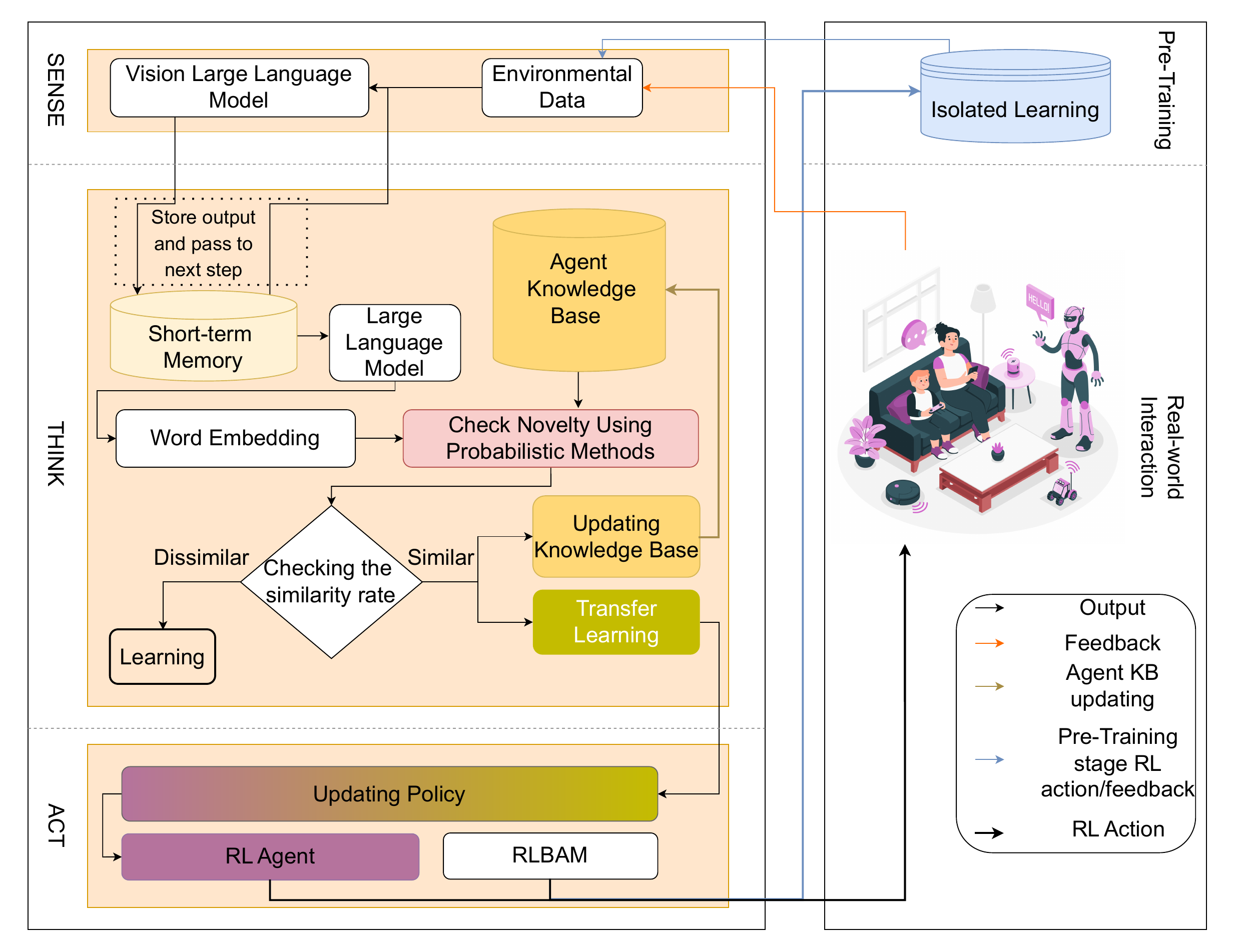
Component Overview
Step-by-Step Processing
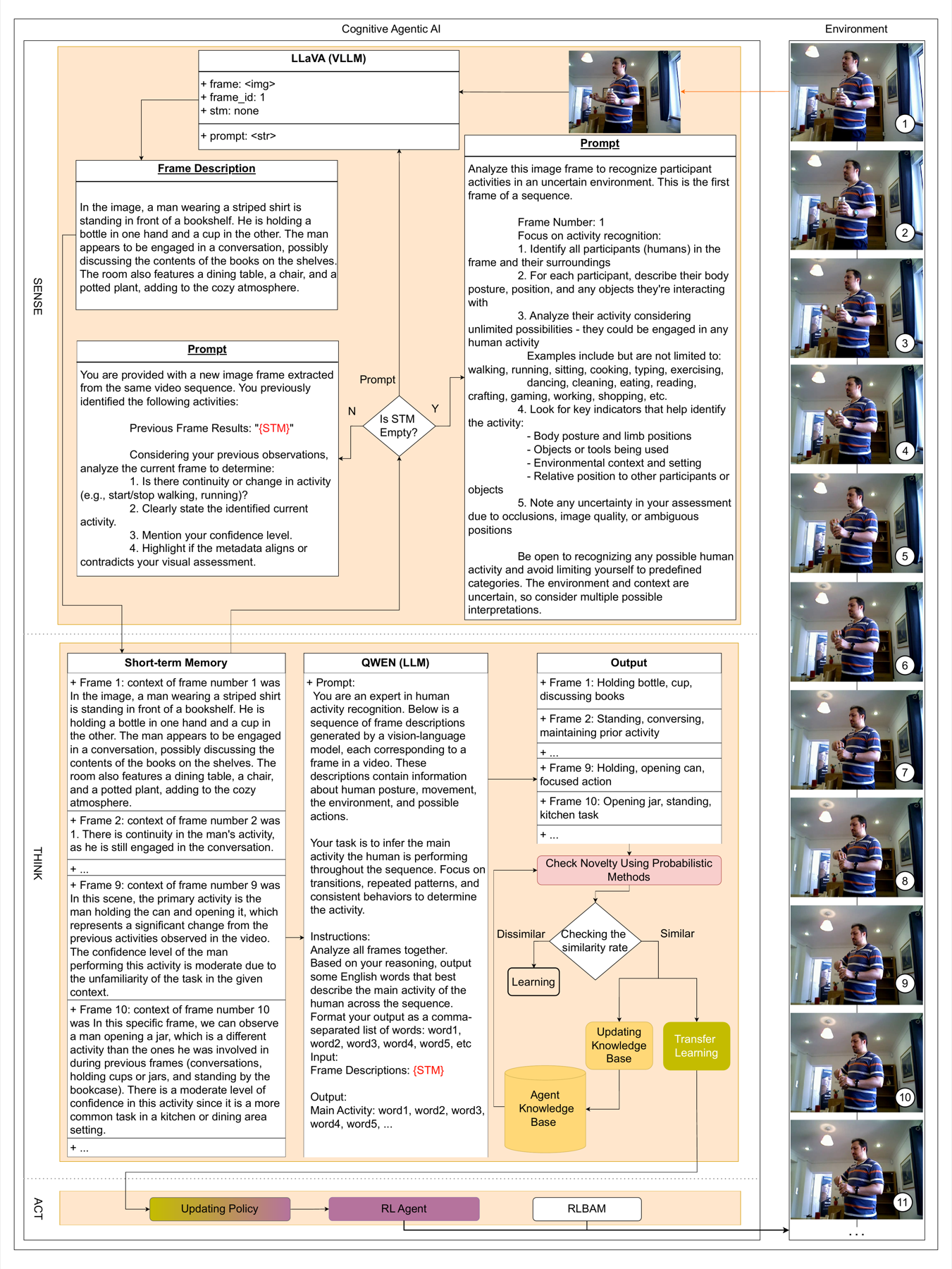
The figure below walks through the Sense--Think--Act cycle on a real example from the RHM dataset. The SENSE stage shows LLaVA processing successive frames with a context-aware prompt that incorporates the prior STM content. The THINK stage demonstrates how frame descriptions accumulate in the buffer across ten frames, followed by Qwen-based semantic aggregation that extracts consolidated activity keywords.
Contribution
ARTEMIS is an architecturally simple, model-agnostic wrapper: the VLM and aggregator remain frozen, while temporal consolidation emerges from the buffer content. This makes the approach compatible with existing single-frame VLMs while maintaining the streaming, low-latency properties required for human-robot interaction.
Key Results
Paired Within-Video Evaluation Across Two Datasets
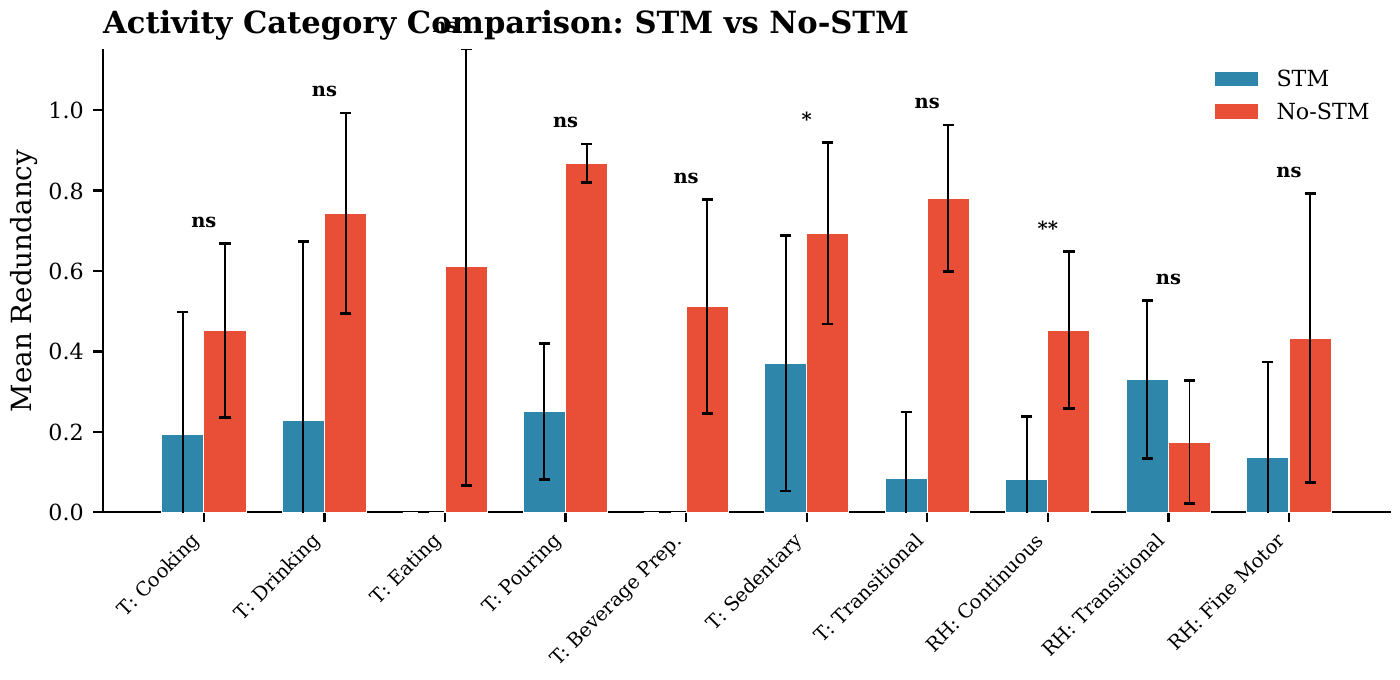
- Toyota Smarthome (29 activities): STM reduces mean keyword redundancy from 0.661 to 0.182 -- a 72.5% reduction. Lower redundancy is achieved in 27 of 29 activities (93.1% win rate), and 20 of 29 activities reach complete redundancy elimination.
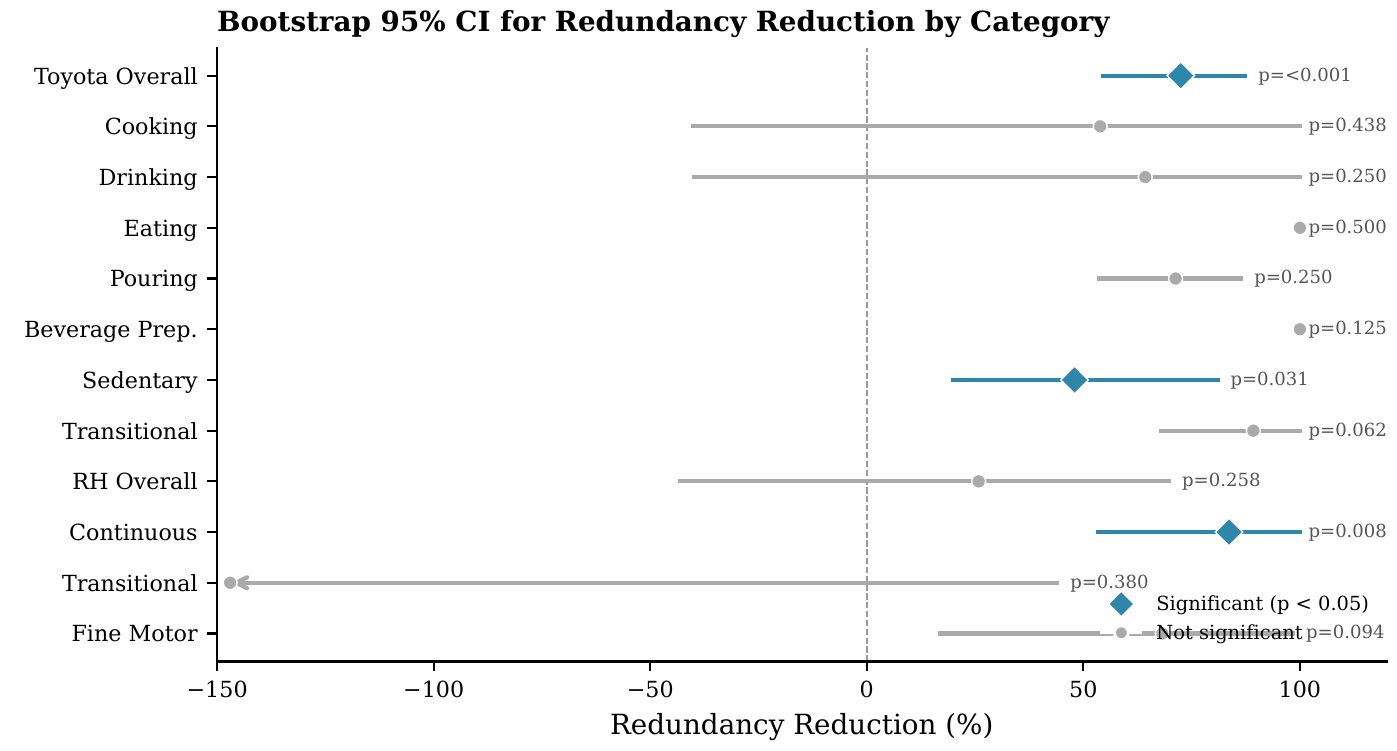
- RHM continuous activities (n = 8): Walking, Drinking, Cleaning and Carrying Object show a 100% win rate and 82.1% relative reduction (Hedges' g = 1.29, padj = 0.024 after Bonferroni correction).
- RHM transitional activities (n = 14): Sitting Down, Standing Up, Stairs Climbing, Lifting and Bending -- STM does not help and slightly increases redundancy, a pattern consistent with event segmentation theory: when the buffer spans a boundary between incompatible states, the aggregator cannot identify a single dominant activity.
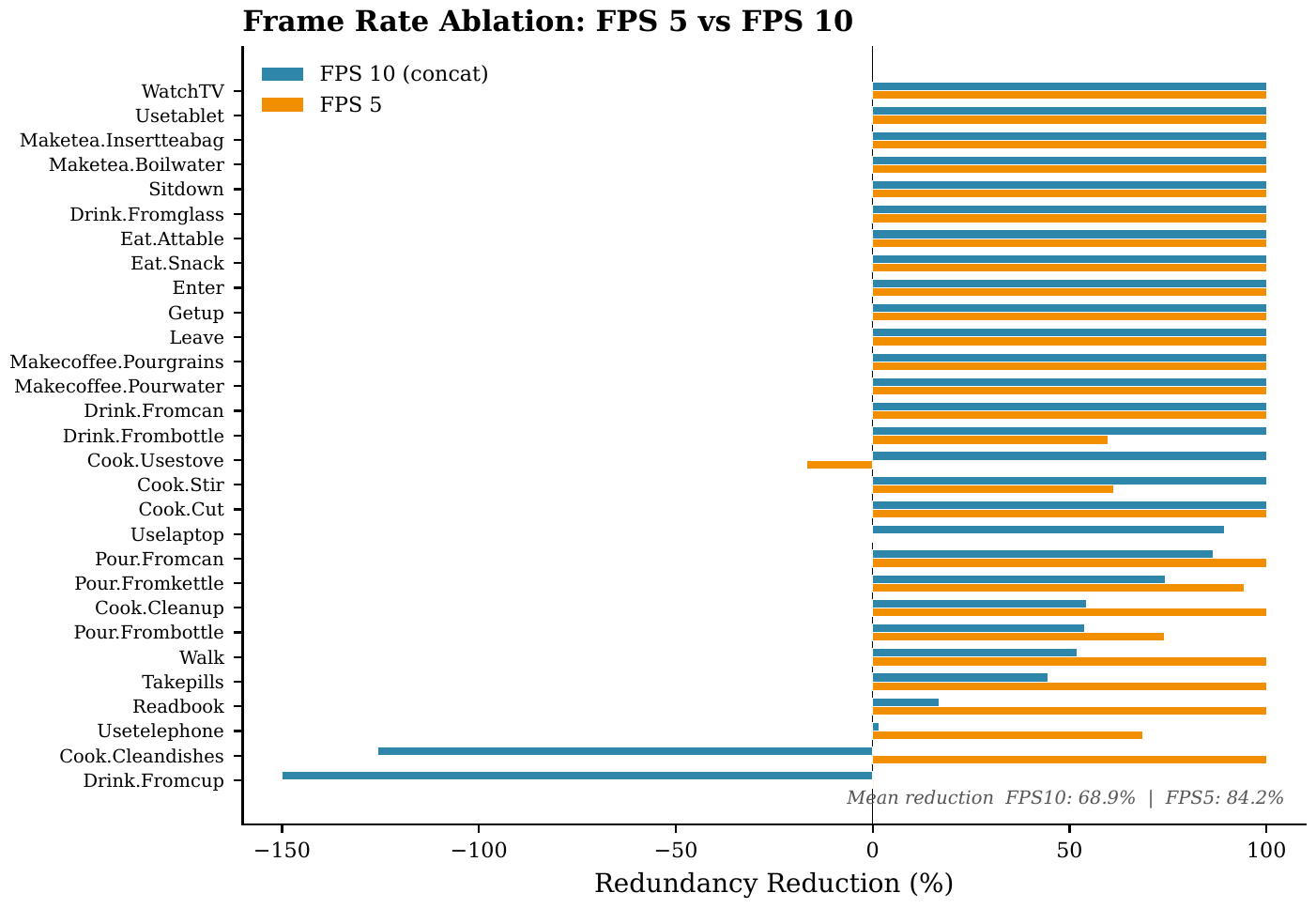
- Temporal coverage ablation: At 5 FPS (where the 10-frame buffer spans 2 seconds), STM achieves a 91.9% reduction compared to 72.5% at 10 FPS. The NoSTM baseline is stable across frame rates, indicating that the effect operates through what is accumulated in the memory buffer rather than through per-frame VLM output alone.
Cross-Dataset Overview
At the aggregate level, STM lowers keyword redundancy on both datasets, but the magnitude of the effect differs. Toyota (predominantly sustained activities) shows a large, consistent reduction with a 93.1% win rate; RHM (half of which is transitional) shows a smaller aggregate effect because STM helps on continuous activities and hinders on transitions.
Per-Activity Breakdown
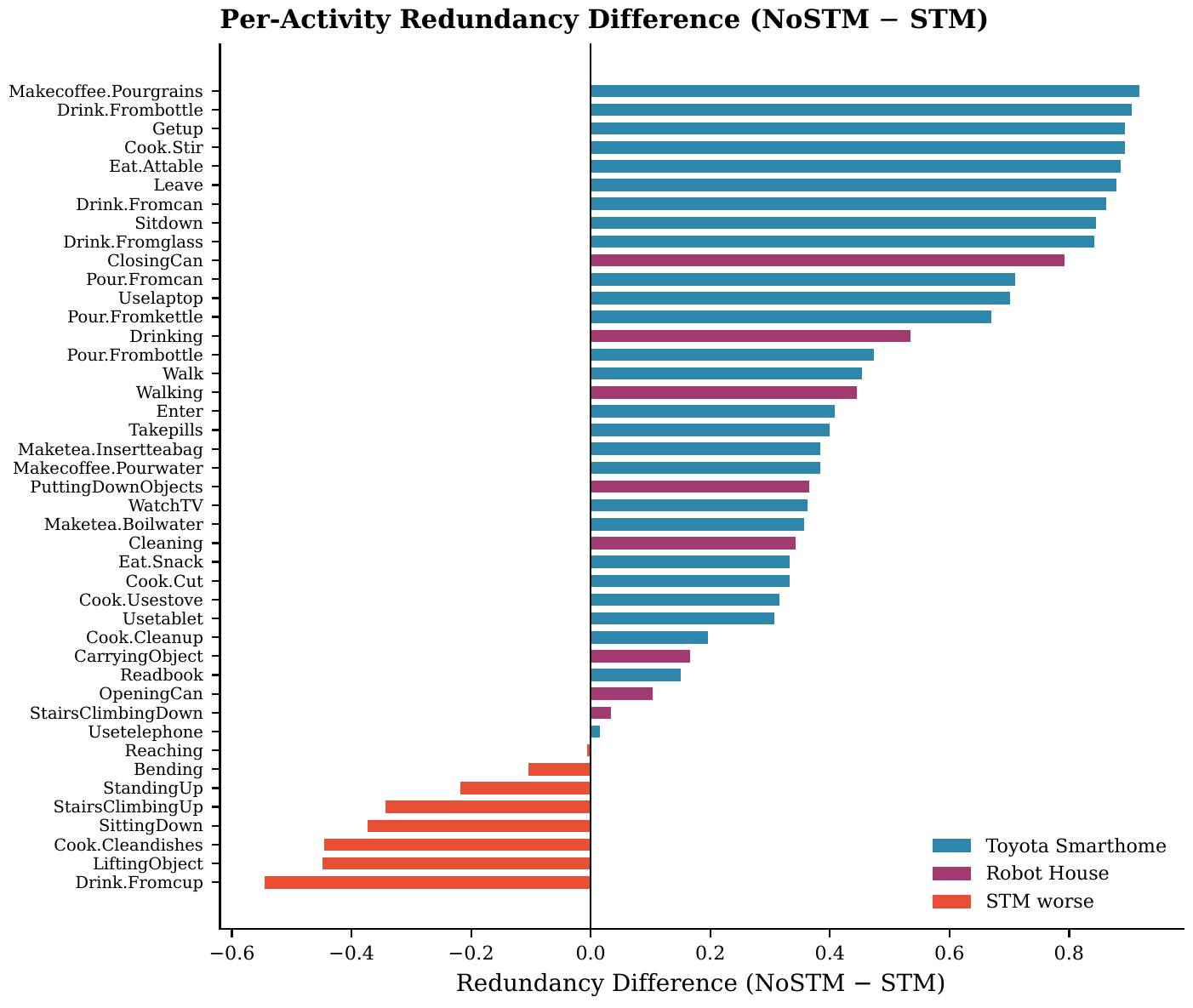
Most Toyota activities achieve complete redundancy elimination under STM; 20 of 29 activities reach zero redundancy, covering all Drinking variants (except From Cup), all Eating activities, all Beverage Preparation activities, and several Cooking and Transitional activities. Two activities (Cook.Cleandishes, Drink.Fromcup) show a degenerate aggregator failure mode where the model produces repetitive templates about the absence of change.
Activity-Dependent Efficacy on RHM
The RHM subgroup analysis reveals a clear dissociation. STM lowers redundancy for Continuous activities (100% win rate, Hedges' g = 1.29) and Fine Motor activities (83% win rate, g = 0.63), but increases redundancy for Transitional activities where the buffer spans a state change and no single dominant activity exists. This is consistent with event segmentation theory and suggests a hybrid pipeline that pairs the STM buffer with a structural-shift detector as a principled next step.
Bootstrap Confidence Intervals
10,000-iteration bootstrap CIs corroborate the subgroup pattern. Continuous (CI [22.8%, 54.3%]) and Fine Motor (CI [3.4%, 60.0%]) both exclude zero; Transitional (CI [-42.0%, 12.4%]) and the Overall estimate both include zero with a negative central tendency for transitional activities. Bootstrap CIs are not Bonferroni-adjusted; correction applies only to the Wilcoxon $p$-values.
Temporal Coverage Ablation
Frame Rate and Memory-Window Span
Lowering the sampling rate from 10 FPS to 5 FPS while holding the buffer at $W=10$ doubles the temporal span covered by the STM buffer (1 s $\to$ 2 s). At 5 FPS, STM reaches a 91.9% redundancy reduction, exceeding the 72.5% obtained at 10 FPS. Crucially, the NoSTM baseline is nearly identical at both rates (0.661 vs 0.645), providing a partial natural control: if the improvement were purely a consequence of the VLM receiving more frames, the NoSTM side would shift too. The observed pattern is consistent with the effect operating through the contents of the memory buffer rather than through per-frame VLM output alone.
Design Implication
For deployment, lower sampling rates -- together with the corresponding wider temporal window -- amplify STM's consolidation benefit and simultaneously reduce GPU load. A disentangled follow-up experiment ($W=10$ at 5 FPS vs.\ $W=20$ at 10 FPS, both spanning 2 s) is needed to separate sampling density from temporal coverage.
Scope and Caveats
We explicitly scope the empirical contribution to representation efficiency -- measured as keyword redundancy reduction -- and not to downstream activity-classification accuracy. Efficiency and accuracy are separable properties that can diverge; validating that the observed efficiency gains translate into improved classification or novelty-detection performance requires a downstream-task evaluation that we flag as the primary follow-up.
The current baseline processes a single frame while STM processes $W=10$ frames, so the observed differences confound temporal consolidation with information quantity. A matched multi-frame baseline (all $W$ frames processed independently, then aggregated) is the definitive causal test and is identified as the highest-priority next experiment.
Honest Framing
This is an exploratory, hypothesis-generating study. We report descriptive statistics on Toyota Smarthome (breadth-first sampling: one video per class across all 29 activity classes) and inferential statistics on the paired RHM design. Sample sizes on RHM subgroups (n = 8 continuous, n = 6 fine motor) are modest; confirmatory evaluation on larger samples is warranted.
Why It Matters
Streaming activity recognition is a foundational capability for autonomous systems deployed in human-centred environments -- healthcare, assisted living, and collaborative robotics. Yet modern VLMs typically process each frame independently, producing repetitive, temporally incoherent outputs that overshadow sustained activities with brief transient events. ARTEMIS advances the field by:
- Introducing an architecturally simple, model-agnostic memory wrapper that retrofits temporal coherence onto any frame-level VLM without fine-tuning.
- Providing empirical evidence that STM benefits are activity-dependent, with sustained (continuous) activities benefiting strongly and transitional activities requiring complementary boundary-detection mechanisms.
- Identifying a natural bridge to the inferred-structure vs in-context learning framework: STM acts as an ICL-style contextual adaptation that dominates under contextual shifts but must be paired with structural mechanisms when tasks change mid-buffer.
- Characterising a redundancy-efficiency-accuracy trade-off that reframes how streaming VLM outputs should be evaluated -- efficiency is measurable now; accuracy requires follow-up downstream-task evaluation.
Impact
ARTEMIS enables memory-augmented VLMs to maintain coherent activity representations across brief interruptions -- a prerequisite for activity-aware dialogue, novelty detection, and safe human-robot interaction in streaming settings.
Open Science & Collaboration
We are committed to open, reproducible research. If you are interested in collaborating, extending the framework, or accessing the experimental data and evaluation scripts, please reach out.
Full Paper & Code
Under review at Expert Systems with Applications (Elsevier). A preprint, code, and experimental materials will be made available at ghamati.com/stm-vlm/ upon acceptance.